
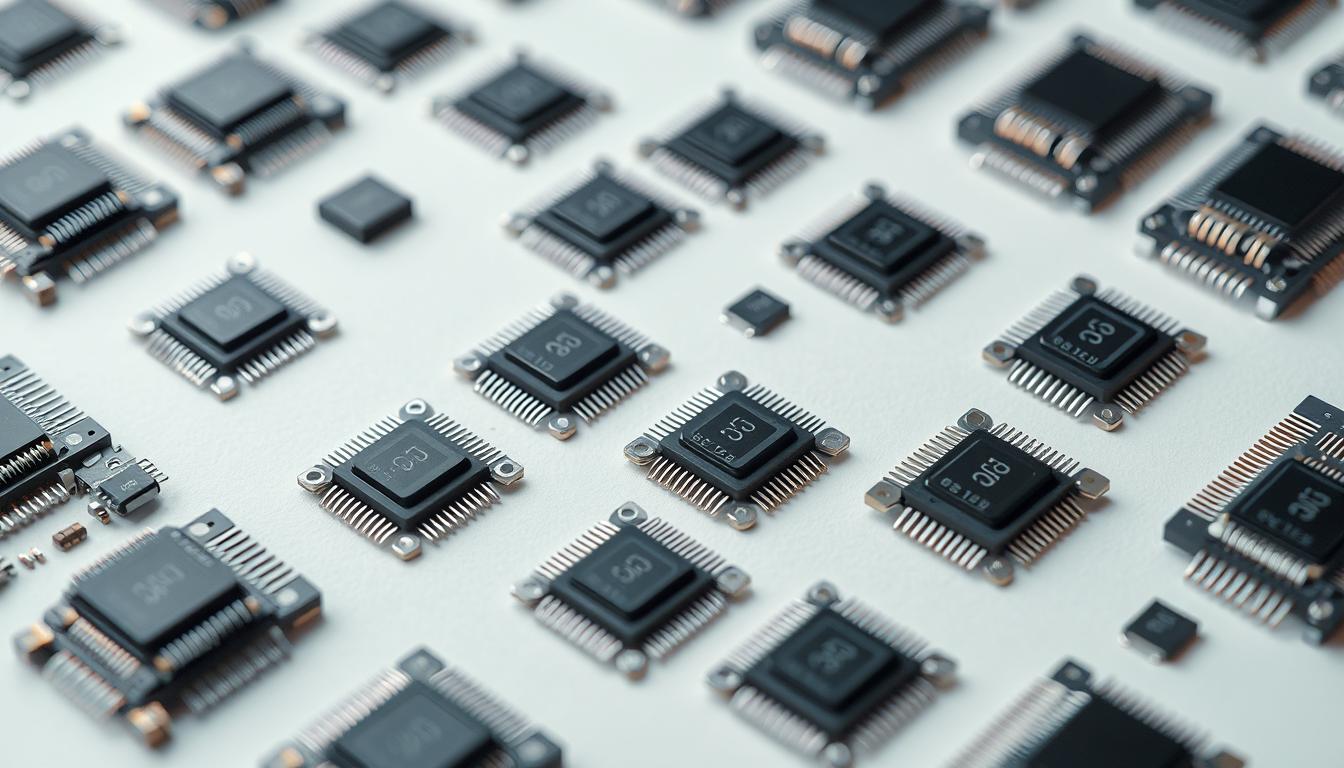
Accelerometers: Complete guide to motion sensors
Les accéléromètres ont transformé notre quotidien. Ces petits dispositifs, intégrés dans nos appareils, révolutionnent notre interaction avec la technologie. Ils mesurent l'accélération avec une précision impressionnante, influençant des secteurs variés, des smartphones aux voitures.
Eukleed, spécialiste en solutions électroniques industrielles, souligne l'importance croissante de ces capteurs. Ce guide est destiné à éclairer, que vous soyez novice ou expert en technologie, sur le fonctionnement et les applications des accéléromètres dans notre société.
We'll explore the different types of accelerometers, their operating principles and their influence on modern technologies. From robust piezoelectric sensors to miniaturized MEMS devices, each type has unique characteristics and specific applications.
Key points to remember
- Accelerometers measure acceleration and movement
- They are omnipresent in our everyday electronic devices.
- There are various types: piezoelectric, MEMS, capacitive, etc.
- Applications range from automotive to consumer electronics
- Precision and sensitivity are crucial parameters
- Regular calibration is essential for reliable measurements
Introduction to modern motion sensors
Modern motion sensors, such as accelerometers, are transforming the way we interact with technology. They measure vibrations, jolts and G-forces, and offer a wide range of applications in many fields.
Definition and fundamental principles
An accelerometer measures the non-gravitational linear acceleration of an object. It detects changes in speed and direction. This enables movements to be analyzed with great precision. These sensors are crucial for measuring vibrations and shocks in various environments.
Historical development of accelerometers
The history of accelerometers goes back to the earliest studies of motion. Their evolution took a significant leap forward with the advent of MEMS technology. This advance enabled the creation of miniaturized, higher-performance sensors. This innovation paved the way for their integration into many everyday devices.
Impact on current technologies
Accelerometers have a considerable impact on modern technology. In automobiles, they contribute to collision detection and vehicle stability. Smartphones use them for screen rotation and navigation. The aerospace industry relies on these sensors for flight navigation and vibration analysis.
The global accelerometer market, estimated at 190.84 billion USD in 2021, is expected to reach 327.90 billion USD by 2029. This testifies to their growing importance.
Accelerometer operating principles
Accelerometers, these advanced devices, are designed to measure linear and angular acceleration. They operate by detecting movement in three dimensions, thanks to their X, Y and Z axes. Their operation is based on Newton's law, which states that force is equal to the product of mass and acceleration.
Their mechanism is based on a tiny mass suspended by microscopic springs. When an acceleration is detected, this mass moves. This enables the sensor to measure this movement precisely. This technology, known as MEMS accelerometers, is ubiquitous in our mobile devices.
There are various categories of accelerometer, each with its own special features:
- Piezoelectric accelerometers use crystals to produce an electrical charge when deformed.
- Piezoresistive accelerometers measure changes in resistance caused by material deformation.
- Capacitive accelerometers detect changes in electrical capacitance induced by mass displacement.
These technologies provide highly accurate acceleration detection. They are crucial for many applications, including drop detection in mobile devices. They are capable of detecting the subtlest vibrations and the most intense shocks.
Accelerometer types available on the market
The accelerometer market features an impressive variety of sensors, meeting a wide range of needs. These devices are essential for measuring the movement and orientation of objects. Let's take a look at the main types of accelerometer and their distinctive features.
Piezoelectric accelerometers
Piezoelectric accelerometers mark the beginning of history. They fall into two categories: high-impedance and low-impedance. High-impedance models are preferred for research, as they can withstand high temperatures. On the other hand, low-impedance versions, equipped with microcircuits, are more common in industry.
Their sensitivity ranges from 0.1 mV/g to 100 mV/g. Ideal for detecting vibrations and shocks, they are widely used in industry. Some miniature models, weighing just 0.2 grams, are ideal for high-frequency applications.
MEMS accelerometers
MEMS (Micro-Electro-Mechanical Systems) accelerometers have transformed industry. Their small size and low cost make them popular in smartphones and other electronic devices. They excel at measuring high-acceleration shocks and are crucial for determining the orientation of devices.
Servo-controlled accelerometers
Capacitive accelerometers, a type of servo-controlled accelerometer, ensure high stability. They are frequently used for modal analysis. Operating over a frequency range from 1 kHz to 20 kHz, they measure accelerations from 2 g to 100,000 g.
The diversity of accelerometers makes it possible to satisfy a variety of needs, from industrial vibration measurement to precise orientation in mobile devices. The choice of type depends on the specific application, environmental conditions and accuracy required.
Industrial motion sensor applications
Accelerometers and motion sensors are transforming industry. They provide innovative solutions in many fields. From predictive maintenance to materials analysis, their impact is profound.
MEMS accelerometers are essential in the automotive industry. They monitor tire pressure and trigger airbags in the event of a collision. These devices significantly improve the safety of modern cars.
The aerospace industry benefits from motion sensors for monitoring engine and wing vibrations. This application optimizes aircraft performance and safety. Piezoelectric accelerometers, with their ability to cover a wide range of frequencies, are ideal for these tasks.
In the healthcare sector, MEMS sensors are integrated into medical devices. They monitor physical movements. Applications range from fitness tracking to real-time health monitoring.
- Predictive maintenance of industrial machines
- Detecting defects in materials
- Optimizing manufacturing processes
- Structural monitoring (bridges, buildings)
Accelerometers are revolutionizing Industry 4.0. Their integration with the Internet of Things enables real-time monitoring. This optimizes the maintenance of industrial systems. These technological advances are paving the way for a safer, more efficient industry.
Accelerometer technologies in mobile devices
Accelerometers are revolutionizing the way we interact with mobile devices. These inertial devices, based on MEMS technology, integrate easily and with low power consumption into our smartphones, tablets and game consoles.
Smartphone integration
Accelerometers in smartphones have an impressive accuracy of 0.01 m/s². They perform 150 measurements per second, determining the orientation and movement of the device. Using springs, these sensors measure the acceleration of a small mass attached to the chassis. They can recognize horizontal or vertical position, lateral movements and even falls.

Use in game consoles
Handheld game consoles use accelerometers to deliver immersive experiences. These sensors detect movements such as tilting, shaking and rocking. This paves the way for innovative and intuitive game controls.
Tablet applications
In tablets, accelerometers are essential to the user experience. They enable automatic screen rotation and improve GPS accuracy. These sensors measure acceleration on three axes (X, Y, Z), including the force of gravity. They offer fascinating possibilities for augmented reality applications.
Key technical parameters
Accelerometers, these complex devices, require careful attention to certain parameters. These directly influence their effectiveness in measuring acceleration and G-force, and are essential in a variety of applications.
Sensitivity and precision
The sensitivity of an accelerometer reflects its ability to detect minute variations in acceleration. It varies considerably according to the type of sensor. Piezoelectric models can reach a few mV/g, while some MEMS can exceed several V/g. Accuracy, meanwhile, can be as low as 0.01% of the measurement scale, a remarkable performance in cutting-edge applications.
Measurement range
The measuring range is crucial, as it defines the acceleration limits that the sensor can measure. It is expressed in g (9.81 m/s²) and can range from ±1g for applications requiring high sensitivity to over 100g for extreme shock situations. The choice of range depends on the intensity of the G forces to be measured in the application.
Bandwidth
Bandwidth is an indicator of how quickly the accelerometer responds to variations in acceleration. For vibration measurements, it generally covers 0 to 10 kHz. A wide bandwidth enables high-frequency movements and vibrations to be captured.
Elements such as the number of axes (1 to 3), power consumption and resistance to extreme conditions also play a role in choosing the right accelerometer for each specific application.
Solutions d'intégration par Eukleed
Eukleed se distingue comme un expert dans l'intégration de capteurs de mouvement inertiels. Avec 30 ans d'expérience, cette entreprise française offre des solutions électroniques et IT industrielles de pointe.
L'intégration des accéléromètres par Eukleed ouvre de nouvelles perspectives. En combinant ces capteurs avec des technologies comme LoRa, GNSS, Wi-Fi et Bluetooth, l'entreprise crée des systèmes de connectivité innovants. Ces solutions trouvent leur place dans la surveillance d'équipements et la gestion de flottes en temps réel.
Eukleed excelle dans l'assemblage de PC industriels et la personnalisation d'affichages. L'intégration d'accéléromètres dans ces systèmes permet de répondre à des besoins spécifiques. Que ce soit pour des applications TFT, OLED ou e-paper, les possibilités sont vastes.
La gestion d'énergie est un autre domaine d'expertise de Eukleed. L'entreprise propose des solutions d'alimentation adaptées aux capteurs inertiels, incluant des batteries lithium et des convertisseurs DC/DC. Cette approche garantit une performance optimale des capteurs de mouvement dans diverses conditions industrielles.
Choisir Eukleed comme partenaire, c'est opter pour une mise en œuvre réussie de solutions basées sur les accéléromètres. Leur expertise technique et leur compréhension des besoins industriels en font un acteur incontournable dans le domaine des capteurs de mouvement.
Accelerometer maintenance and calibration
Regular maintenance and accurate calibration of accelerometers are crucial to ensure reliable vibration and shock measurements. This ensures the accuracy and durability of these sensitive devices.
Calibration procedures
Accelerometer calibration involves several essential steps. A portable vibration calibrator, such as Brüel & Kjær's model 4294, creates a standard vibration of 10 m/s² at 159.15 Hz. The accelerometer output is then measured and compared with this reference. This process verifies the sensitivity of the sensor and the integrity of the measurement system.
Recommended maintenance frequency
Quality accelerometers are subject to variations of less than 2% over long periods. However, periodic sensitivity checks are recommended. These checks ensure that the sensor is not damaged and remains accurate for measuring vibrations and shocks. The exact frequency of these checks depends on use and environment, but an annual check is often recommended.
Good usage practices
To preserve the accuracy of accelerometers, it is essential to follow good operating practices. This includes careful handling, correct mounting on the surfaces to be measured, and compliance with the environmental limits specified by the manufacturer. Particular attention must be paid to temperature and humidity conditions during measurements, as they can influence sensor performance.
FAQ
What is an accelerometer and how does it work?
An accelerometer is a device that detects the acceleration of an object. It operates according to Newton's law, where a small mass, connected to microscopic springs, reacts to the forces of acceleration. This motion is converted into an electrical signal, enabling vibrations and jolts to be measured. It can even measure G-force.
What types of accelerometer are available?
Accelerometers fall into several categories. Piezoelectric accelerometers use crystals to produce an electrical signal. MEMS accelerometers are miniaturized and affordable. Finally, servo-driven accelerometers are designed for high-precision applications.
How are accelerometers used in smartphones?
Accelerometers in smartphones enable automatic screen rotation. They also improve GPS accuracy and help optimize battery consumption. What's more, they are essential in a variety of applications, such as games and fall detection. Their role is crucial in enhancing the user experience.
What are the industrial applications of accelerometers?
Accelerometers are indispensable in industry. They are used for predictive machine maintenance and vibration analysis. They also detect defects in materials and optimize industrial processes. Their usefulness is immense in sectors such as automotive, aerospace and construction.
What are the most important technical parameters to consider for an accelerometer?
Sensitivity, accuracy, measurement range and bandwidth are key criteria. Sensitivity enables detection of small movements. Accuracy is essential for reliable measurement. Measurement range, often expressed in G-force, determines the accelerometer's capacity. Bandwidth, on the other hand, influences its ability to react to rapid changes in acceleration.
Comment Eukleed intègre-t-il les accéléromètres dans ses solutions ?
Eukleed, avec 30 ans d'expérience, combine les accéléromètres à des technologies avancées. Il utilise le LoRa, le GNSS, le Wi-Fi et le Bluetooth pour créer des solutions innovantes. L'entreprise développe des applications industrielles avancées, allant de la surveillance des équipements à la gestion de flottes en temps réel.
What is the importance of accelerometer maintenance and calibration?
Maintenance and calibration are essential to the accuracy and reliability of accelerometers. Calibration procedures ensure that measurements remain accurate. Maintenance frequency depends on use and environment. It is important to protect accelerometers from excessive shock and extreme conditions.
How can accelerometers help improve automotive safety?
Accelerometers play a crucial role in vehicle safety systems. They are used in stability control systems, airbags and collision detection. These sensors enable rapid reaction in the event of an accident, improving passenger safety.
What's the difference between an accelerometer and a gyroscope?
Accelerometers and gyroscopes are often used together, but measure different aspects. An accelerometer detects linear acceleration and can indicate orientation relative to gravity. A gyroscope, on the other hand, measures angular velocity and is used to detect rotation. Their combination in mobile devices improves motion detection.